Failure Is Not the Finish Line: Building Courage in a High-Pressure World
In a culture shaped by rankings, instant feedback and online comparison, the fear of failure can stop young people before they begin. This article explores how students can move from perfectionism and avoidance towards preparation, reflection and the confidence to try again.
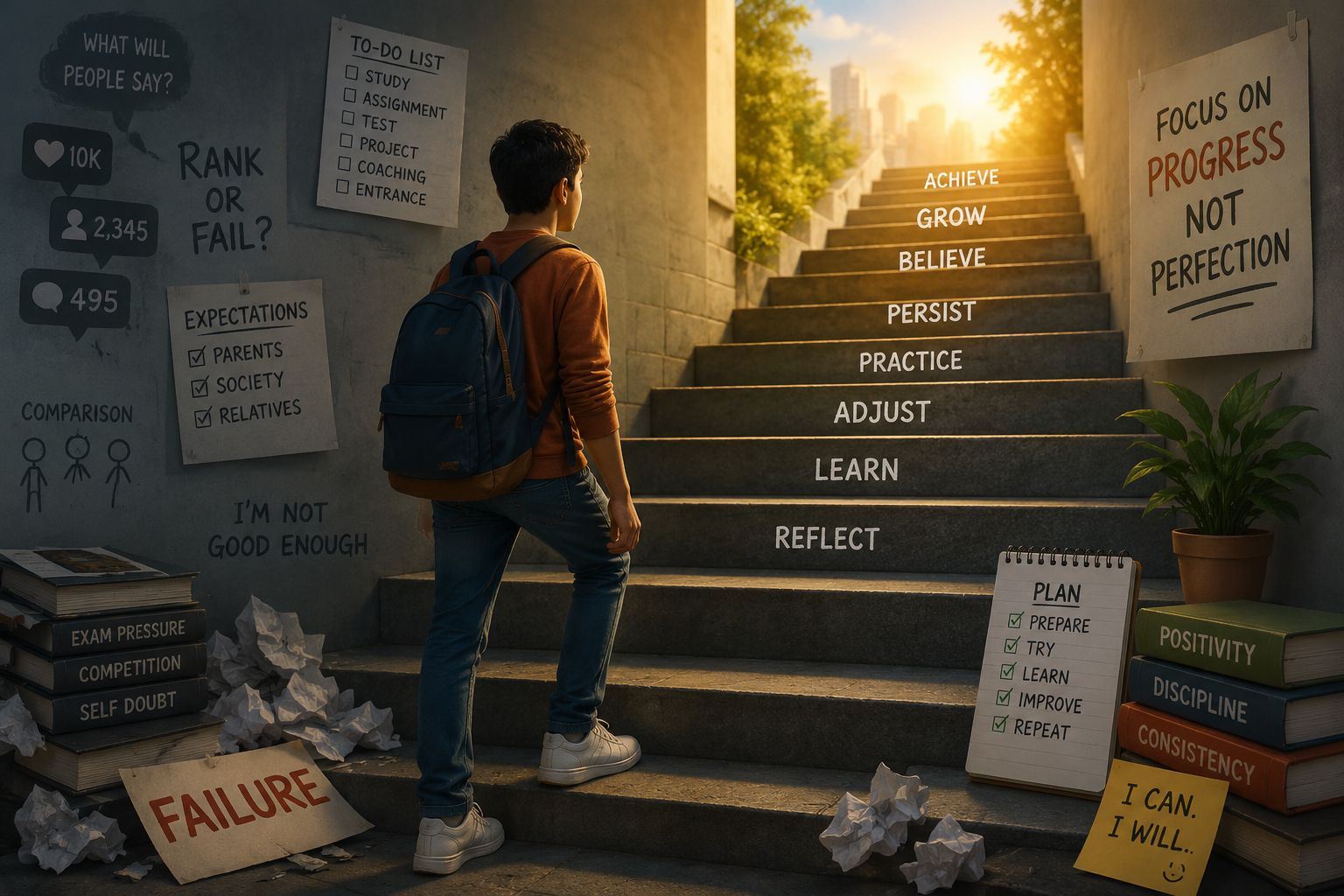
Why Failure Feels More Public Today
Failure has always been uncomfortable, but today it can feel unusually visible. Marks may be compared in group chats, performances may be recorded and shared, and achievements are often displayed online without the setbacks that came before them. As a result, students may begin to believe that everyone else is progressing smoothly while they alone are struggling.
This environment can turn an ordinary mistake into a threat to one’s identity. A low score may feel like proof of being ‘not intelligent enough’. Rejection from a team, competition, internship or university may be interpreted as a verdict on the future. Even creative interests can become stressful when students begin measuring their work through views, likes, comments or public approval.
Fear of failure is not simply the wish to do well. It becomes a problem when the possibility of an imperfect result causes a person to avoid trying, delay important work, hide mistakes or choose only tasks that feel completely safe.
How Fear of Failure Shows Up
Fear does not always look like panic. Sometimes it appears as procrastination: a student postpones an assignment because beginning it would expose what they do not yet know. It may appear as perfectionism, with hours spent adjusting minor details while the main task remains unfinished. It can also look like indifference, where a student says, ‘I did not care anyway,’ to protect themselves from disappointment.
Some students avoid asking questions because they fear appearing weak. Others refuse opportunities, auditions, competitions or leadership roles because rejection would feel embarrassing. A learner may repeatedly seek reassurance, compare their progress with others or become extremely upset by small corrections.
Technology has created new forms of avoidance as well. A student may rely too heavily on digital tools or artificial intelligence to produce a polished answer because they are afraid their own first attempt will not be good enough. Used responsibly, such tools can support learning. Used to escape the discomfort of thinking, drafting and revising, they can quietly weaken confidence.
The Cost of Always Playing Safe
Avoiding failure may bring temporary relief, but it also limits growth. Students develop confidence by experiencing manageable challenges, making mistakes and discovering that they can recover. When every risk is avoided, the mind never receives evidence that difficulty can be handled.
Fear can also encourage self-sabotage. A person may begin preparing too late, withdraw effort or set unrealistic goals. If the result is poor, they can tell themselves that the outcome does not reflect their true ability because they never fully tried. This protects the ego in the short term but prevents honest improvement.
Over time, fear of failure can narrow choices. Students may select subjects only because they are likely to score well, remain silent during discussions, avoid unfamiliar activities or abandon meaningful goals before giving themselves a fair chance.
Failure Is Information, Not Identity
A disappointing result describes what happened in one attempt under particular conditions. It does not define a person’s intelligence, worth or future potential. The useful question is not, ‘What is wrong with me?’ but, ‘What can this result teach me?’
A poor outcome may reveal that a strategy was ineffective, instructions were misunderstood, preparation was inconsistent, time was mismanaged or support was needed earlier. Sometimes the goal itself may need to change. Reflection transforms failure from a personal label into practical information.
This does not mean pretending that failure is enjoyable. Rejection and disappointment can hurt, especially when a person has worked hard. A healthy response allows space for those emotions while preventing them from becoming permanent conclusions.
Modern Scenarios: Choosing Courage Over Perfection
A student receives a lower-than-expected examination score. Instead of hiding the paper or deciding they are incapable, they review the mistakes, speak with the teacher and practise the specific skills that were weak.
A learner wants to participate in a public-speaking competition but worries about forgetting a line. Rather than waiting to feel completely confident, they rehearse in smaller settings, prepare cue cards and accept that nervousness can exist alongside action.
A student posts artwork online and receives little response. Instead of treating low engagement as proof that the work has no value, they seek constructive feedback, continue practising and remember that algorithms and popularity are not reliable measures of creativity.
A learner uses an AI tool to brainstorm ideas but writes, checks and improves the final response independently. The goal is not to produce work that looks flawless instantly, but to strengthen their own thinking through the process.
Practical Ways to Reduce the Fear
Break large goals into smaller experiments. ‘Prepare the perfect presentation’ creates pressure; ‘draft the opening slide today’ creates a clear next step. Small actions reduce the drama surrounding the final outcome.
Set process goals alongside result goals. A result goal may be to win a competition. A process goal may be to practise four times, request feedback and improve one skill. Results are influenced by many factors, while processes are more directly controllable.
Plan for setbacks before they happen. Ask: What will I do if the first attempt does not work? Having a response plan makes failure feel less like a cliff and more like a bend in the road.
Replace harsh self-talk with accurate language. Instead of saying, ‘I always fail,’ say, ‘This attempt did not work, and I need a different strategy.’ Accuracy is more useful than forced positivity.
Create a record of progress. Keeping drafts, practice videos, reflections or previous work helps students see improvement that may be invisible from day to day.
Seek feedback early. Waiting until work feels perfect often increases anxiety. Early feedback allows correction while the task is still developing.
How Adults Can Help
Parents and educators influence how children interpret mistakes. When adults react to every low mark with alarm, comparison or criticism, students may learn that achievement is the condition for approval. When adults focus only on praise, students may also become afraid of losing the image of being ‘naturally talented’. Balanced feedback is more useful.
Adults can ask questions such as: What did you try? What worked? Where did you get stuck? What will you change next time? These questions communicate that ability can develop through strategy, practice and support.
It is equally important not to romanticise struggle. Repeated failure without guidance can be discouraging. Students need appropriate instruction, realistic expectations, timely feedback and access to help. Courage grows when challenges are demanding but manageable, not when young people are left to struggle alone.
Schools and families can normalise revision by sharing drafts, corrections and behind-the-scenes processes. Celebrating improvement, responsible risk-taking and thoughtful reflection creates a healthier culture than celebrating only winners and top scores.
When Fear Needs More Support
Some anxiety before an important task is normal and can encourage preparation. However, support may be needed when fear causes persistent distress, sleep problems, panic, frequent physical complaints, avoidance of everyday activities or a significant decline in functioning.
A trusted adult, teacher, counsellor or qualified mental-health professional can help a student understand the fear and develop healthier coping strategies. Asking for support is not evidence of weakness; it is a practical response when a problem begins controlling daily life.
The Courage to Begin Again
Success is rarely a straight line. Learning involves uncertainty, incomplete first attempts, correction and repetition. The aim is not to become fearless, because fear often appears whenever something matters. The aim is to prevent fear from making every decision.
Students do not need proof that they will succeed before they begin. They need a manageable next step, honest feedback and permission to learn in public. Failure may close one route, expose a weakness or require a change of plan, but it does not have to become the finish line.
Progress belongs not only to those who succeed quickly, but also to those who can examine an imperfect result, adjust their approach and begin again with greater understanding.
Editorial Note
This article is intended for educational awareness. Persistent anxiety or distress that interferes with daily life should be discussed with a trusted adult or qualified mental-health professional.